How Vereign’s Bulgarian Development Centre Is Tackling Uncontrolled Personal Data Processing
Originally published in Forbes Bulgaria, 23 September 2025. By Hristo Petrov.
The market for self-sovereign identity solutions is poised to explode to $38 billion within the next five years. A Swiss startup with a development centre in Bulgaria has already taken pole position
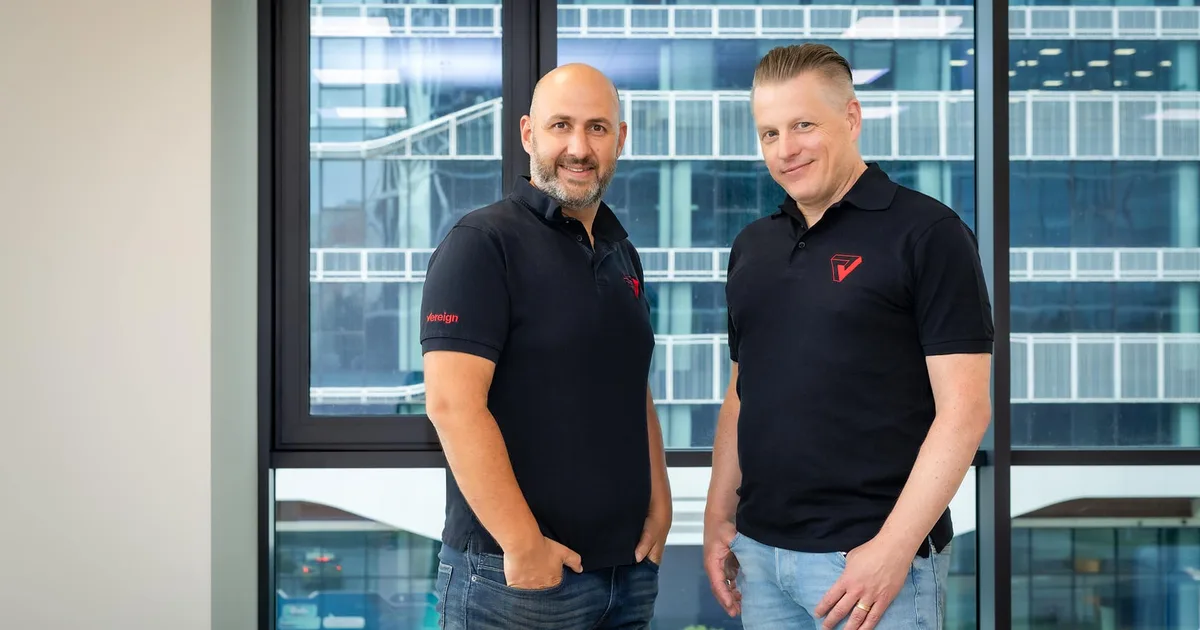
Less than five minutes into his interview with Forbes, Georg Greve is already digging deep into the problem of user data that the big internet platforms collect — and why he doesn’t like it.
“Centralised identification systems have an inherent tendency to create monopolies, to lock in users and to deny them control,” says the co-founder of Vereign, gently tapping his hand on the table in the company’s Sofia office. “This is a deep architectural problem that is rooted in the way the internet works.”
Here is a very simplified example. When you log into another online service using your Facebook profile, Facebook effectively serves as a guarantor that you are you and acts as an identity provider. But if the provider knows everything about you and stores the information in its own database, what happens if the database is compromised? Greve believes the solution lies in self-sovereign identity (SSI).
This is a relatively new concept that began gaining popularity in 2016 and, according to analysts, has significant market potential. Currently valued at just $2 billion, the global SSI market is expected to exceed $38 billion by 2030 according to Grand View Research. That would represent an average annual growth rate of over 66%.
And Greve and his right-hand man Kalin Canov, who runs Vereign’s Bulgarian office, believe they hold the key to this market. Vereign is one of the first companies attempting to monetise SSI as a solution for secure storage and sharing of information. Almost immediately after its registration in Switzerland, the company opened an office in Bulgaria, where its development activities and a large proportion of its employees are concentrated today.
Vereign’s business model resembles that of RedHat. The company deploys open-source products for its clients and makes money from consulting and technical support. To date, the startup has announced CHF 2.5 million in raised investment, while the Bulgarian entity “Vereign Labs” has revenues of just over BGN 1 million per year for 2023.
Vereign is one of the subcontractors on projects for the creation of Gaia-X: a system of rules and standards for building information infrastructure within the European Union. In addition to working on a project basis, the company also develops its own products: such as technology for secure email sending or a wallet for storing digital identity.
Greve is one of the early advocates for the idea of self-sovereign identity. Born in Germany, at the beginning of the 21st century he was the driving force behind the creation of the Free Software Foundation Europe, which promotes the use of open-source software (something that the big software companies often do not want).
After spending years as CEO of Kolab Systems, which developed an open-source platform for team collaboration, Greve founded Vereign in Switzerland, with the help of his brother Fabian. Kalin Canov joined the company after receiving an invitation from a friend with the recommendation: “You have to come to this company, because its DNA is very different.” Canov accepted the offer.
The company’s main product SEAL enables verified email sending and authentication in data exchange. From the very beginning, Greve’s idea was for the product to be compatible with major email service providers such as Microsoft and Google.
Integrating a digital privacy product with the products of a brand like Google, which makes money exclusively through the processing of personal data, may sound absurd at first glance. “After all, their business model is the exact opposite of what we do,” says Kalin Canov.
Vereign SEAL is installed as a browser extension and works as an additional layer of protection that prevents emails from being falsified. In this way, the solution does not directly confront the business model of the big tech companies, which — Greve is convinced — continue to collect data about their users, even when they throw around terms like “anonymised user data” or “zero-knowledge proof” in the public sphere.
“They tell you: ‘Oh, now Google uses zero-knowledge proof,’ but actually they continue to know everything about you and where you’ve been doing what,” says Greve.
Vereign is betting on the idea that SSI as a principle for data storage will be widely adopted across various sectors. The company points to the Swiss healthcare sector as an example, where SEAL is used for secure email sending.
Greve believes that other sectors such as finance, legal services, and the defence industry are also ready to adopt SEAL as a solution, and that this will catalyse Vereign’s growth.
“In five years we will be much larger: probably five times larger as a company, and our client base will be much broader,” says Greve. “By that time, the entire healthcare sector will be using our technology, including in Bulgaria, Germany and other countries.”
Photo: Elena Nenkova for Forbes Bulgaria
Originally published in Forbes Bulgaria, 23 September 2025.