Applying Authenticity to Swiss Healthcare — FOSSASIA 2025
Talk summary: In March 2025, Georg Greve presented “Applying Authenticity to Swiss Healthcare” at FOSSASIA Summit in Bangkok (Security track). The talk draws on eight years of building Self-Sovereign Identity infrastructure — Vereign was founded in Zug in 2017, contributed its SSI stack to the Eclipse Foundation, and has grown to 16 FTE entirely focused on making authenticated, trustworthy digital interaction a practical reality.
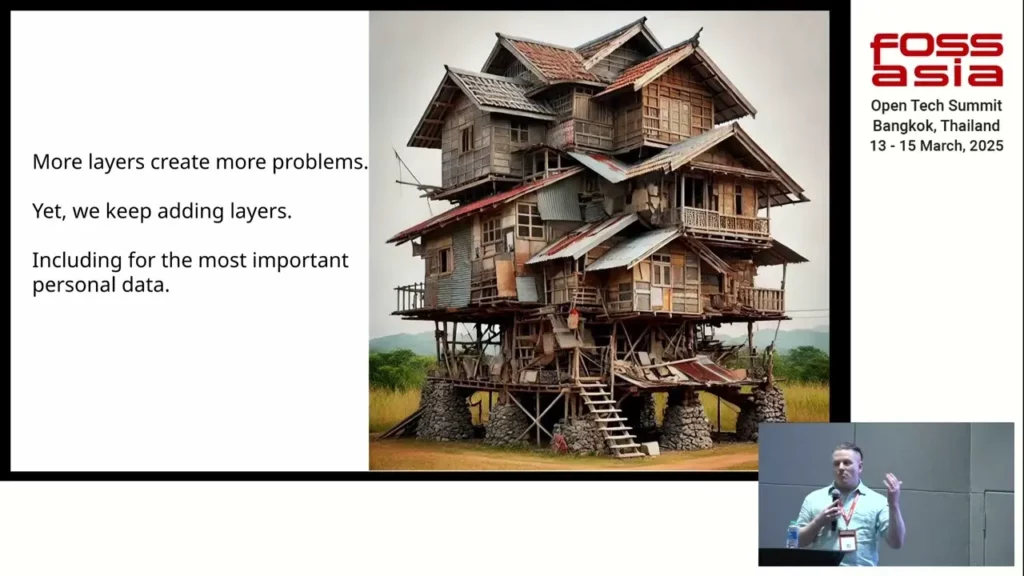
The web was designed for knowledge sharing, not identity. Early computers had no accounts, no passwords — security was bolted on later, and each layer of bolted-on trust (TLS, DNSSEC, Trust Service Providers) drove further centralisation. Richard Stallman’s observation that “security” drove the platform economy turned out to be structurally true: as trust required intermediaries, those intermediaries captured identity, then monetised it. Gaia-X offered a serious European attempt to reclaim sovereignty over digital infrastructure — but executed on the same broken architecture. The lesson is not to rebuild a broken design, but to build a better one. That means designing for decentralisation from first principles, treating peer-to-peer authenticity — the way paper works — as the foundation rather than the exception.
Swiss healthcare provides the proof point. HIN (Health Info Net AG), founded in 1996 by Swiss doctors, operates the secure communications network for Swiss healthcare — approximately 850+ Stargate gateways, over 30,000 GP offices, and more than 800,000 verified deliveries per month. SEAL was deployed as the starting point of what is becoming the communication layer on top of Stargate: it handles external outbound communication from HIN to recipients outside the network, using encrypted swarm delivery to reach insecure edge devices while preserving the authenticity of the sender. Recipients can independently access their messages, know they have not been altered or intercepted, and reply securely to their doctor. The ongoing operational transformation — from S/MIME gateways to Stargate infrastructure — is multi-year: hospital and institutional gateways in 2026, with HIN Clients in GP offices planned next and dates announced as scheduled.
The “applications of authenticity” framing matters. This is not identity infrastructure for its own sake — it is practical authenticated interaction at scale, in a regulated industry, with real patients and real clinical consequences. Open source is the mechanism: by advancing DKMS (Decentralised Key Management System) and contributing to shared infrastructure, Vereign and its partners are building economies of scale for the sovereign technology community that no single vendor can achieve alone. The talk closes with an invitation to collaborate — not a product pitch, but a call to the open-source community at FOSSASIA to engage with a working deployment.
Watch the full talk above to see the architecture diagrams, the DKMS/KERI/OCA stack explained from first principles, and the Stargate deployment roadmap for Swiss healthcare. Questions and collaboration opportunities: reach out to the Vereign team.